
Table of Contents
FCC Greenlights High-Power 6 GHz Devices in Unanimous Vote
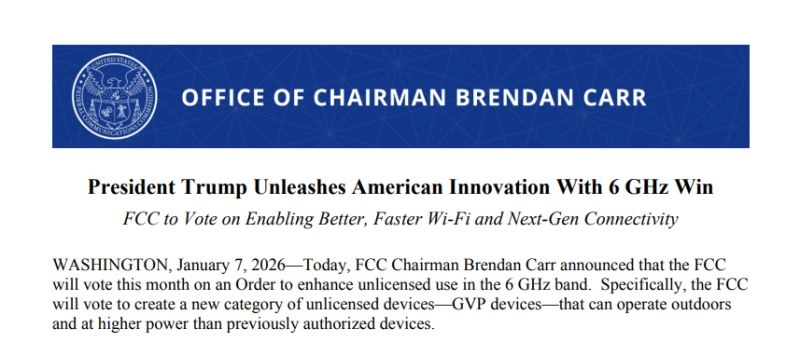
The U.S. Federal Communications Commission (FCC) has unanimously approved expanded unlicensed operations in the 6 GHz spectrum, introducing a new class of higher-power devices. This decision, finalized in late January 2026, promises to supercharge broadband access for applications ranging from virtual reality gaming to cruise ship connectivity and remote education.
Background on 6 GHz Spectrum Evolution
The 6 GHz band represents a critical slice of mid-band spectrum, sitting between crowded 2.4 GHz and 5 GHz WiFi frequencies. Initially opened for unlicensed use in 2023, the band has already fueled WiFi 6E adoption. The FCC's 2023 proposal sought to further unleash innovation by allowing higher power levels, a move supported by industry groups like the Computer & Communications Industry Association (CCIA). CCIA filed comments emphasizing efficient spectrum use for consumer products.
This latest order builds on that foundation. Higher-power devices can now operate without automated frequency coordination (AFC) in certain scenarios, reducing interference risks while enabling broader coverage. Stephanie Joyce, CCIA's Senior Vice President and Chief of Staff, hailed the move: "The FCC should be commended for delivering on America’s shared goal of maximizing our use of wireless spectrum. This order will fuel the services that power gaming, education, healthcare, and workforce development."
Technical Implications for Telecom and WiFi 7
Engineers view 6 GHz as pivotal for WiFi 7 (802.11be), which promises multi-gigabit speeds, ultra-low latency and 320 MHz channels. Higher power means small cells and access points can cover larger areasup to 4x the range of low-power indoor devicesideal for enterprises, stadiums and vessels. Expect deployments in dense urban environments where 5G densification meets WiFi offload needs.
- Power Classes Defined: Standard Power (SP) devices up to 36 dBm EIRP outdoors; Very Low Power (VLP) remains for portable gear.
- Interference Safeguards: Incumbent licensed users protected via AFC for outdoor SP ops above 5.925 GHz.
- Channel Bandwidth: Full 500 MHz availability (5.925-7.125 GHz) accelerates 320 MHz WiFi 7 channels.
This aligns with RAN market stabilization forecasts. Dell'Oro Group's January 27, 2026 report predicts worldwide RAN revenues growing at 1% CAGR through 2030, with 5G offset by early 6G ramps. Stabilizing capex precedes spectrum-driven upgrades like 6 GHz WiFi integration.
Impact on Telecom Operators and Consumers
For cable giants like Charter, this complements converged strategies. Charter's Q4 2025 results show 11.8 million mobile lines and plans for Invincible WiFia WiFi 7 router with 5G backup launching early 2026. Spectrum Mobile leverages such spectrum for no-contract 5G plans.
Consumers gain seamless connectivity: VR headsets stream without lag, remote workers access 10 Gbps home networks, and cruise ships deliver shipwide broadband. Broader implications tie into AI-native networks and Open RAN growth6 GHz offloads traffic from cellular, easing densification costs pegged at billions globally.
Operators face permitting hurdles but reap efficiency. AI-driven automation, a $4.7 billion market in 2025, optimizes these hybrid WiFi-5G fabrics. As 5G hits 2.8 billion connections (Q3 2025), unlicensed spectrum prevents bottlenecks.
Global Context and Future Outlook
While U.S.-focused, the FCC move influences international standards. Europe and Asia eye similar 6 GHz unlocks, syncing with 6G prep. Dell'Oro notes RAN's historical 0% CAGR (2000-2025) but expects 6G capex by 2030 to lift revenues.
Risks persist: data traffic slowdowns could mute demand, per Stefan Pongratz of Dell'Oro. Yet improved 6G sentiment counters downside. Cybersecurity looms tooCisco's January 26 study flags AI accelerating privacy investments amid telecom risks.
This FCC vote marks a telecom inflection: from 5G peaks to spectrum abundance fueling edge innovation. By 2027, expect 6 GHz devices ubiquitous in routers, CPE and enterprise gear, bridging WiFi and cellular eras.